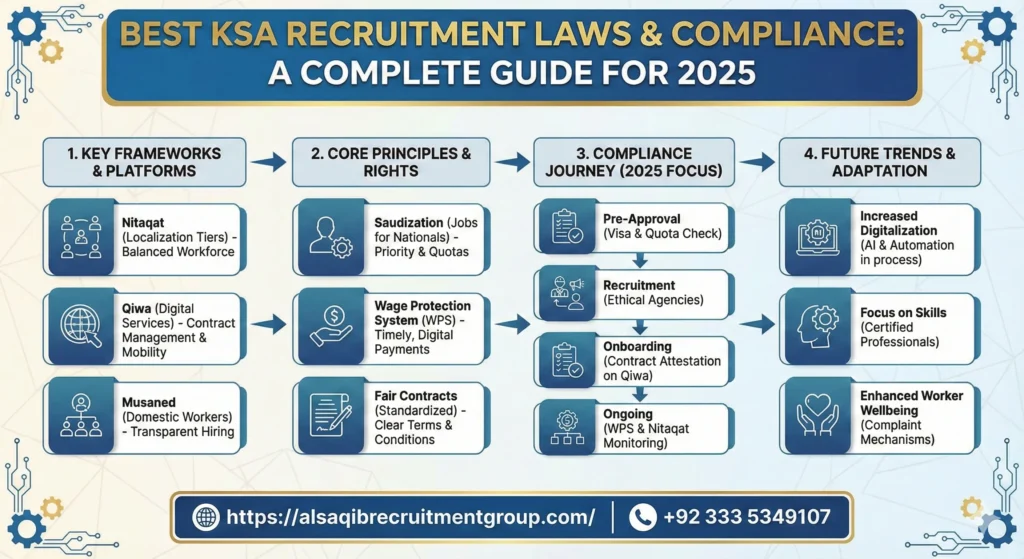
Saudi Arabia’s recruitment industry has rapidly evolved under Vision 2030. As more international and local companies expand operations, understanding KSA recruitment laws and compliance has become critical for employers and manpower agencies alike.
Recruiting workers in Saudi Arabia requires compliance with strict government regulations — from Saudization (Nitaqat) to licensing and visa sponsorships. Non-compliance can result in fines, blacklisting, or suspension of operations.
This guide outlines the top recruitment laws in KSA, employer obligations, penalties for non-compliance, and best practices to ensure compliance. Whether you’re a business hiring manpower or a recruitment agency sourcing overseas talent, this article will help you navigate the Saudi employment framework with confidence.
1. Understanding the KSA Recruitment Laws and Compliance
Framework
Saudi Arabia’s recruitment and employment framework is governed primarily by the Saudi Labor Law issued by Royal Decree No. M/51 (2005) and its amendments. The law outlines the rights, obligations, and working conditions for both Saudi and expatriate employees.
The system ensures transparency and fairness while promoting employment opportunities for Saudi nationals. The Ministry of Human Resources and Social Development (MHRSD) oversees all employment-related activities and ensures employers adhere to the law.
Key objectives of the framework include:
Protecting employee rights and employer interests
Ensuring fair recruitment practices
Promoting localization through Saudization policies
Regulating foreign manpower recruitment agencies in Saudi Arabia
2. Licensing Requirements for Recruitment Agencies
To operate as a recruitment agency in Saudi Arabia, companies must obtain a license from the Ministry of Human Resources and Social Development (MHRSD). This ensures that all agencies follow ethical and legal recruitment processes.
Key requirements include:
Minimum capital investment (as defined by MHRSD)
A valid commercial registration certificate
Proof of office space and legal address in KSA
Qualified management and HR staff
Compliance with recruitment and visa regulations
Unlicensed recruitment activities can lead to severe penalties, including license revocation and permanent bans from operating in the Kingdom.
3. Saudization (Nitaqat) Policy
The Saudization Program (Nitaqat) is one of the most important compliance areas in Saudi recruitment. It mandates private companies to employ a specific percentage of Saudi nationals.
The policy divides companies into colored categories — Platinum, Green, Yellow, and Red — based on compliance levels.
Key compliance insights:
Platinum and High Green companies enjoy visa privileges and faster services.
Yellow and Red companies face restrictions on renewing expatriate work permits.
Industries such as retail, healthcare, and hospitality have specific Saudization quotas.
Tip: Always monitor your Nitaqat status through the MHRSD portal and plan your workforce accordingly.
4. Employment Contracts and Offer Letters
Every employment relationship in Saudi Arabia must be documented through a written contract. The contract must clearly state:
Job title and responsibilities
Salary, allowances, and benefits
Contract duration (fixed-term or indefinite)
Working hours, overtime, and leave policies
Termination clauses
Both parties must sign the contract in Arabic (and optionally English). The employer must provide a copy to the employee.
Compliance tip: Never allow an employee to start work without a signed contract registered under the company’s Qiwa platform.
5. Sponsorship (Kafala) System Updates
Saudi Arabia has reformed the traditional Kafala (Sponsorship) system to improve worker mobility and rights.
Key reforms include:
Employees can now change jobs without their employer’s consent after completing the contract terms.
Exit and re-entry permits can be applied for directly through the government portal.
Employers are still responsible for issuing initial work visas and residency permits (Iqama).
These reforms aim to increase workforce flexibility and improve Saudi Arabia’s reputation for fair labor practices.
6. Recruitment of Foreign Workers
Recruitment of foreign manpower is strictly regulated under the Labor Law and Ministerial Decrees.
Employers must:
Obtain recruitment approval through the Qiwa or Musaned platform.
Use only licensed overseas recruitment agencies.
Provide workers with a valid job offer, contract, and visa before travel.
Bear all associated recruitment and travel costs (except optional expenses by worker).
Prohibited practices:
❌ Charging workers recruitment fees
❌ Submitting false job offers
❌ Employing undocumented or overstaying workers
Violations can lead to fines up to SAR 50,000 and potential blacklisting of the company.
7. Equal Opportunity and Non-Discrimination
Under Saudi Labor Law, discrimination on the basis of gender, age, disability, or nationality is prohibited. The MHRSD requires equal pay for equal work and fair treatment for all employees.
Employers must ensure:
Companies found guilty of discriminatory practices can face penalties, compensation claims, and loss of Nitaqat privileges.
8. Health, Safety, and Welfare Obligations
Recruitment compliance extends to occupational health and safety.
Employers must provide:
A safe work environment free from hazards
Health insurance (mandatory for all employees)
Regular medical checkups and emergency facilities
Training on workplace safety
The MHRSD conducts regular inspections. Non-compliance can lead to fines, closure orders, or license suspensions.
9. Termination and End-of-Service Benefits
Employment termination must follow the conditions specified in the Saudi Labor Law. Arbitrary dismissal or violation of notice periods is prohibited.
Key rules:
Notice period: 30 days (monthly paid employees)
End-of-Service Benefits (EOSB): ½ month’s salary per year for the first 5 years, 1 month’s salary thereafter
Employers must provide experience certificates upon termination
All payments must be made before the employee’s final exit visa is issued.
10. Record Keeping and Digital Compliance
With the introduction of digital platforms like Qiwa, GOSI, and Musaned, compliance has become more traceable and automated.
Employers must ensure:
All contracts are uploaded to Qiwa
Social insurance registration under GOSI
Wage Protection System (WPS) compliance for monthly payments
Digital record of employee leaves and attendance
Failure to update records or falsifying data can trigger legal action and heavy fines.
11. Penalties for Non-Compliance
Violating recruitment or labor regulations in KSA can result in:
MHRSD has an active inspection department and uses data from platforms like Qiwa and WPS to identify violations automatically.
12. Best Practices for Recruitment Compliance in KSA
To maintain a strong reputation and avoid penalties, follow these best practices:
✅ Work with licensed recruitment agencies only
✅ Use digital platforms like Qiwa & Musaned for documentation
✅ Monitor Nitaqat status regularly
✅ Maintain updated employee records
✅ Train HR staff on Saudi labor laws
✅ Keep contracts transparent and bilingual
✅ Implement WPS and GOSI compliance
Companies that adopt compliance-first strategies build trust with regulators and employees, improving their overall brand image.
13. The Role of Recruitment Agencies in Compliance
Professional recruitment agencies like Alsaqib Recruitment Group play a crucial role in ensuring compliance with KSA labor laws.
How Alsaqib Recruitment Group Ensures Compliance:
Works exclusively with licensed overseas partners
Verifies all documentation before worker deployment
Provides ethical recruitment with zero worker-paid fees
Assists employers with visa processing and digital platform registrations
Ensures alignment with Saudization targets and industry quotas
Partnering with a reputable agency like Alsaqib Recruitment Group eliminates legal risks and ensures a seamless hiring process in the Kingdom.
14. Recent Reforms in Saudi Recruitment Laws (2023–2025)
Saudi Arabia continuously updates its recruitment policies to align with Vision 2030. Some key updates include:
Introduction of the “Labor Reform Initiative (LRI)” for better worker mobility.
Enhanced Wage Protection System (WPS) to ensure timely salary payments.
Online tracking of recruitment agency performance.
Digital integration of Musaned, Qiwa, and Absher platforms for transparency.
These reforms are designed to attract foreign investment and build a modern, compliant workforce ecosystem.
15. Conclusion
Saudi Arabia’s recruitment sector is one of the most regulated in the Middle East, emphasizing fairness, safety, and national employment goals. Staying compliant with KSA recruitment laws is not just a legal necessity — it’s a foundation for sustainable business growth.
Whether you’re a local company hiring expatriates or an international recruitment agency sending manpower to the Kingdom, compliance ensures credibility and trust in the Saudi market.
Call to Action
Looking for a trusted recruitment partner in Saudi Arabia?
Alsaqib Recruitment Group ensures 100% compliance with KSA labor laws and Saudization requirements. From candidate sourcing to visa processing and documentation, Alsaqib simplifies your recruitment process while keeping your business fully compliant.
📞 Get in touch today to start your recruitment journey with confidence.