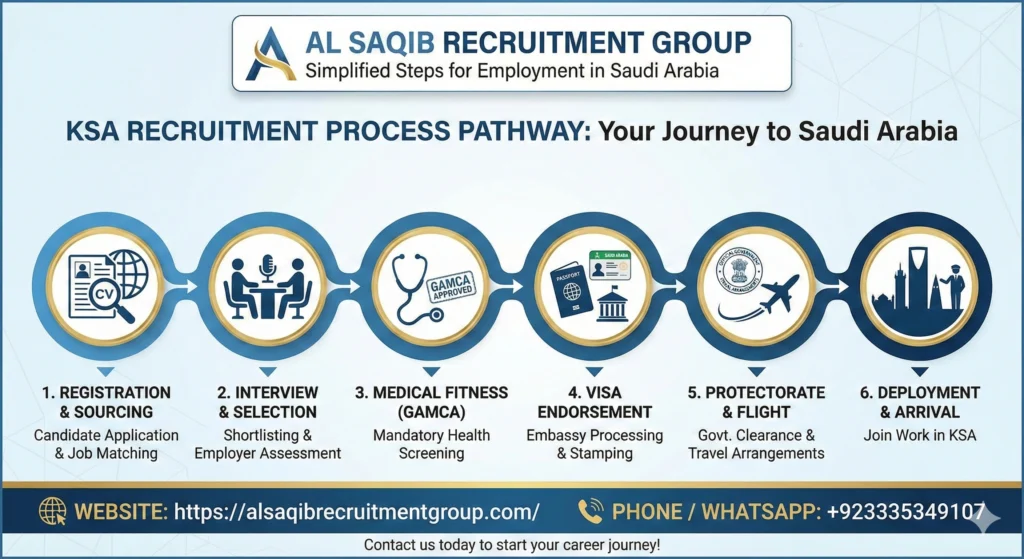
Recruitment Process in Saudi Arabia Explained Hiring in Saudi Arabia is not just about selecting a qualified candidate it’s about following a structured legal and procedural framework that ensures compliance with Saudi labor laws. Whether it’s for construction, healthcare, oil & gas, hospitality, or domestic staffing, every step of recruitment must align with the Ministry of Human Resources and Social Development (MHRSD) guidelines.
For most companies, handling these steps alone can be time-consuming and complicated. That’s why many employers partner with a recruitment agency in Saudi Arabia, such as Alsaqib Recruitment Group, to manage the process from start to finish efficiently and legally.
This article explains how recruitment works in Saudi Arabia covering everything from job analysis to deployment so employers and candidates can understand the full picture.
1. Understanding Recruitment Process in Saudi Arabia Explained
The Saudi labor market is unique because it involves both local (Saudi nationals) and expatriate workers. The government enforces a Saudization policy (Nitaqat system) that sets specific quotas for hiring Saudi citizens in private sector jobs. At the same time, many industries depend on foreign manpower due to skill shortages.
Therefore, recruitment in Saudi Arabia generally falls into two main categories:
-
Local Recruitment: Hiring Saudi citizens or expatriates already residing in the Kingdom.
-
Overseas Recruitment: Hiring skilled workers from abroad—most commonly from Pakistan, India, the Philippines, Bangladesh, or Egypt.
Both processes require specific documentation, approvals, and compliance steps, which a licensed recruitment agency handles on behalf of the employer.
2. Step-by-Step Recruitment Process in Saudi Arabia
Here’s a breakdown of how the full recruitment process typically works in the Kingdom:
Step 1: Job Requirement Analysis
Every recruitment process begins with a clear understanding of what the company needs. This includes:
-
Job title and role
-
Required skills and qualifications
-
Experience level
-
Number of vacancies
-
Salary package and benefits
-
Working hours and conditions
The recruitment agency works closely with the employer to define these requirements in detail. For overseas hiring, the job description must be officially approved before foreign candidates can be recruited.
Step 2: Approval from the Ministry of Labor (If Hiring Expatriates)
Before a company can hire foreign workers, it must obtain permission from the Ministry of Human Resources and Social Development (MHRSD). The employer must show that:
-
The required skill is not readily available among Saudi nationals.
-
The company holds a valid commercial registration (CR) and Saudization certificate.
-
The job roles comply with Saudi labor classifications.
Once the request is approved, the company can begin sourcing candidates from abroad.
Step 3: Sourcing Candidates
Recruitment agencies maintain a wide network of qualified candidates, both locally and internationally. Sourcing can include:
-
Searching agency databases
-
Partnering with overseas agents
-
Advertising through official job portals
-
Shortlisting candidates based on experience, education, and specialization
Agencies like Alsaqib Recruitment Group specialize in connecting Saudi employers with verified talent across multiple countries and industries.
Step 4: Screening and Shortlisting
After sourcing, the agency screens candidates through:
-
Resume and document verification
-
Preliminary interviews (in-person or virtual)
-
Trade testing (for technical roles)
-
Language and communication assessments
-
Medical fitness verification (initial check)
Only candidates who meet the client’s criteria are shortlisted for final interviews.
Step 5: Employer Interview and Selection
Shortlisted candidates are presented to the employer for review. The client may:
-
Conduct interviews (online or through local representatives)
-
Request skill assessments or portfolio reviews
-
Provide feedback and final approval
Once the final selection is made, the employer issues a job offer letter that includes all employment terms salary, benefits, and responsibilities.
Step 6: Documentation and Employment Contract
For overseas hires, the following documents are prepared:
All documents must comply with the requirements of the Saudi embassy and labor authorities in the worker’s home country.
The employment contract is then attested by the Saudi Chamber of Commerce and the Saudi Embassy, confirming its authenticity.
Step 7: Visa Processing and Work Permit
Once the documentation is complete, the next step is visa processing.
The main stages include:
-
Visa Application: The employer applies for a work visa through the Saudi Ministry of Foreign Affairs (MOFA).
-
Visa Authorization: A unique authorization number is issued for the candidate.
-
Visa Stamping: The Saudi embassy in the candidate’s home country stamps the visa after verifying all documents.
-
Iqama Processing: Upon arrival, the worker’s Iqama (residence permit) is processed, allowing legal employment.
Recruitment agencies coordinate these steps to ensure accuracy and avoid any legal complications.
Step 8: Medical and Security Clearance
All foreign workers are required to undergo a medical examination in their home country at approved centers. This ensures they are physically fit to work and free from contagious diseases.
Security clearance may also be required depending on the job category. Once both are cleared, the worker is eligible to travel to Saudi Arabia.
Step 9: Travel and Deployment
After visa stamping and clearance, the recruitment agency arranges:
For domestic and skilled labor categories, the agency ensures smooth arrival and joining at the employer’s location.
Agencies like Alsaqib Recruitment Group take responsibility for the worker’s safe deployment and ensure proper communication between both parties.
Step 10: Post-Placement Support
Professional recruitment agencies don’t stop after deployment. They follow up to ensure:
-
The worker has safely joined the company
-
The contract conditions are respected
-
Both employer and employee are satisfied
This post-placement support builds long-term trust and helps reduce turnover rates.
3. Legal Framework Governing Recruitment
Recruitment in Saudi Arabia is governed by a strict legal structure to protect both employers and workers.
Key authorities include:
-
Ministry of Human Resources and Social Development (MHRSD): Regulates employment laws and Saudization.
-
Saudi Chamber of Commerce: Attests contracts and trade licenses.
-
Saudi Embassy / Consulate: Validates overseas documents and visas.
-
General Organization for Social Insurance (GOSI): Registers employees for social security.
Recruitment agencies must hold a valid license issued by the MHRSD and operate according to ethical recruitment standards, ensuring transparency and fairness.
4. Local vs. Overseas Recruitment: Key Differences
| Aspect |
Local Recruitment |
Overseas Recruitment |
| Target Candidates |
Saudi nationals and expatriates in KSA |
Foreign workers (Asia, Africa, etc.) |
| Approvals Needed |
Minimal, within labor law |
Requires MOFA and embassy clearance |
| Duration |
1–2 weeks |
4–8 weeks |
| Common Industries |
IT, Retail, Banking |
Construction, Oil & Gas, Healthcare |
| Agency Role |
Job matching and onboarding |
Full-cycle recruitment and deployment |
Both types require compliance, but overseas recruitment is more document-intensive and demands expert handling—making professional agencies invaluable.
5. Benefits of Using a Recruitment Agency in Saudi Arabia
Partnering with a recruitment agency in Saudi Arabia offers major advantages:
-
Expertise in legal processes
-
Access to verified global talent pools
-
Faster hiring turnaround
-
Reduced administrative workload
-
Compliance assurance
Alsaqib Recruitment Group, for example, specializes in connecting Saudi employers with reliable and skilled manpower from multiple countries, managing everything from candidate screening to visa issuance.
6. Challenges in the Recruitment Process
Despite strong systems, companies face several challenges:
-
High demand for specialized workers
-
Lengthy documentation procedures
-
Visa or quota restrictions under Saudization
-
Language and cultural barriers with foreign workers
-
Fraudulent overseas agents
Working with a reputable and licensed recruitment partner helps overcome these challenges effectively.
7. Tips for Employers
To ensure a smooth recruitment process:
-
Work only with licensed recruitment agencies
-
Verify candidate credentials thoroughly
-
Plan manpower needs in advance
-
Ensure transparent communication about job roles
-
Comply with Saudization requirements
These practices save time, prevent legal complications, and lead to successful long-term hiring outcomes.
8. The Role of Technology in Modern Recruitment
The Saudi job market is evolving with digital transformation. Recruitment agencies now use:
-
AI-powered screening tools
-
Online interviews and video assessments
-
Automated document tracking systems
-
Digital visa application portals
This digital shift enhances speed, accuracy, and transparency—benefiting both employers and job seekers.
Conclusion
The recruitment process in Saudi Arabia is detailed and regulated, ensuring fair treatment and professional standards across industries. From defining job roles to visa processing and deployment, every step requires accuracy and legal compliance.
Partnering with a reliable recruitment agency in Saudi Arabia, like Alsaqib Recruitment Group, helps companies navigate these steps effortlessly. With extensive experience, strong global networks, and full compliance with Saudi labor laws, Alsaqib Recruitment Group provides trusted manpower solutions for businesses across the Kingdom.
Whether you’re hiring skilled technicians, healthcare professionals, domestic staff, or corporate executives, working with an experienced agency ensures that your recruitment process is smooth, transparent, and fully compliant with Saudi law.