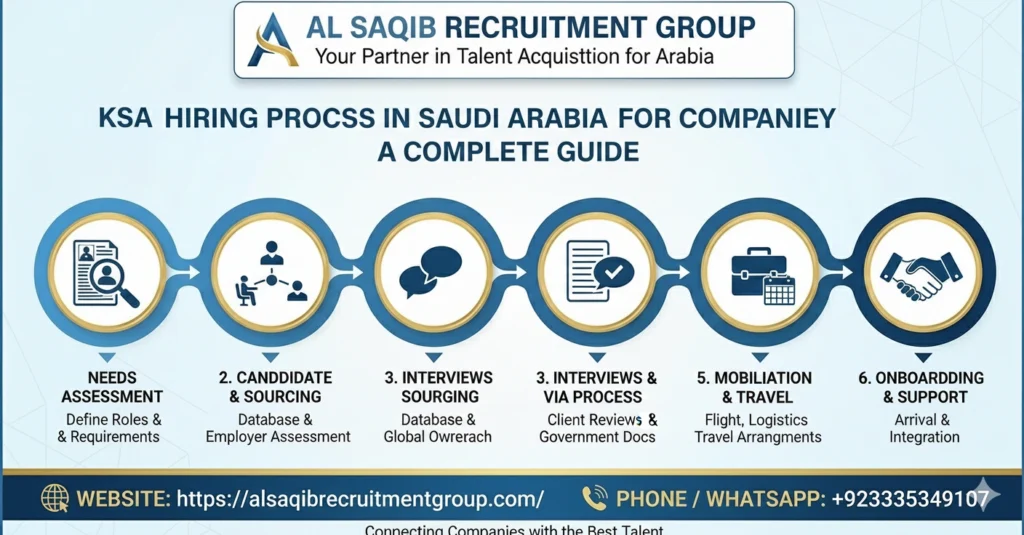
Hiring process in Saudi Arabia for companies is not just about filling a vacancy it’s about building a workforce that aligns with the country’s legal framework, cultural expectations, and long-term business goals. From understanding the Saudization policy to managing visa formalities for expatriates, every company operating in the Kingdom must follow a well-defined process.
That’s why partnering with a recruitment agency in Saudi Arabia has become essential for many employers. Agencies like Alsaqib Recruitment Group simplify the entire hiring cycle helping companies find skilled, compliant, and trustworthy candidates faster while ensuring full alignment with Saudi labor laws.
Whether you run a construction firm in Riyadh, a hospital in Jeddah, or a corporate office in Dammam, the right recruitment partner can make your hiring process seamless and legally sound.
Why Choosing the Right Hiring process in Saudi Arabia for companies
The success of your hiring process depends on finding a recruitment partner that understands Saudi labor policies, Saudization targets, and the documentation required for both local and overseas hiring. A professional agency streamlines recruitment by sourcing, screening, and verifying candidates while managing all visa and legal formalities on behalf of employers.
Alsaqib Recruitment Group, a leading recruitment agency in Saudi Arabia, plays a vital role in connecting companies with qualified talent across industries from healthcare and construction to hospitality and oil & gas. Their expertise ensures compliance, efficiency, and reliability throughout the entire hiring journey.
Job Requirement and Workforce Planning
The hiring process starts long before posting a vacancy. Companies must clearly define their manpower requirements based on ongoing projects, expansion plans, or organizational restructuring.
This stage involves identifying:
-
The job title and department
-
The number of employees required
-
Educational and technical qualifications
-
Work experience
-
Salary range, benefits, and allowances
-
Contract type (temporary, permanent, project-based)
Once these details are finalized, HR teams or recruitment agencies prepare job descriptions that align with Saudi labor regulations.
Partnering with a recruitment agency in Saudi Arabia helps employers create detailed job profiles that attract the right candidates and ensure legal accuracy from the beginning.
Approval and Documentation
Before hiring, companies need to ensure they have a valid Commercial Registration (CR), an active Saudization certificate, and the necessary labor quota approvals.
For local hires, this step is straightforward. But when recruiting expatriates, employers must obtain permissions from the Ministry of Human Resources and Social Development (MHRSD) and sometimes from the Ministry of Foreign Affairs (MOFA) for work visa issuance.
These approvals confirm that the company is authorized to hire foreign workers and that the positions comply with Saudi employment classifications.
Candidate Sourcing and Outreach
After approvals, companies or their recruitment partners begin sourcing candidates. In Saudi Arabia, candidate sourcing can happen through several channels, including:
-
Local job boards and employment portals
-
Social media platforms like LinkedIn and Bayt.com
-
Internal referrals
-
University partnerships for Saudi graduates
-
Overseas agents and networks (for foreign manpower)
Recruitment agencies play a crucial role here because they maintain extensive candidate databases across various countries. Alsaqib Recruitment Group, for example, collaborates with international partners in Pakistan, India, the Philippines, Nepal, and Egypt to find reliable and skilled candidates quickly.
This global network ensures that employers can fill positions efficiently, whether for engineers, nurses, drivers, or domestic staff.
Screening and Evaluation
Screening candidates properly is one of the most critical phases in the hiring process. Companies evaluate applicants based on:
-
Educational and professional qualifications
-
Previous employment records
-
Technical skill levels
-
Language proficiency
-
Character and background verification
For technical or trade-based roles, practical testing is often conducted to assess real skills. For corporate and managerial positions, structured interviews help gauge leadership, communication, and adaptability.
Recruitment agencies conduct initial screenings and interviews before forwarding shortlisted candidates to the employer. This pre-screening ensures that only qualified and suitable individuals move forward, saving time and effort for company HR teams.
Interview and Selection Process
Once candidates are shortlisted, employers conduct interviews either face-to-face, via video conferencing, or through authorized agency representatives.
The interview process in Saudi Arabia is professional and straightforward. Employers focus on verifying expertise, language fluency, and cultural fit. Technical interviews may be combined with HR evaluations to ensure the candidate aligns with company values and expectations.
After all interviews are complete, the employer finalizes the selected candidate(s) and issues a formal job offer letter. This letter includes all employment details—salary, benefits, working hours, duration of the contract, and location of work.
Employment Contract Preparation
Once the offer is accepted, the next step is drafting a legally valid employment contract. In Saudi Arabia, employment contracts must comply with the Saudi Labor Law and typically include:
Contracts are written in Arabic (and sometimes bilingual) and are attested by the Saudi Chamber of Commerce. For overseas hires, these contracts are further attested by the Saudi Embassy in the worker’s home country to ensure legitimacy.
Work Visa and Immigration Process
For expatriate employees, obtaining a work visa is a key part of the hiring journey.
The employer must submit an application to the Ministry of Foreign Affairs (MOFA) and receive a visa authorization number. This authorization allows the worker to apply for a visa in their home country through the Saudi embassy.
The process includes:
-
Submission of attested documents and employment contract
-
Medical examination at approved centers
-
Visa stamping by the Saudi embassy
Once the visa is issued, the recruitment agency arranges the candidate’s travel to Saudi Arabia and coordinates with the employer for arrival and onboarding.
Upon arrival, the company processes the Iqama (residence permit) for the employee. The Iqama serves as the official identification document for all expatriates working in Saudi Arabia.
Onboarding and Integration
The onboarding stage is where new employees are introduced to the company’s culture, systems, and policies. It includes orientation sessions, HR briefings, and introduction to work environments.
For expatriate workers, onboarding also includes:
-
Accommodation arrangements
-
Health insurance registration
-
Opening of bank accounts
-
Safety training for industrial jobs
A smooth onboarding experience helps new employees settle quickly, reduces turnover, and boosts job satisfaction.
Professional agencies like Alsaqib Recruitment Group provide post-placement support to ensure both the employer and employee are satisfied after deployment.
Legal Compliance and Documentation
Saudi Arabia enforces strict employment regulations to protect both employers and workers. Companies must maintain compliance with:
-
Saudization (Nitaqat) targets
-
Labor contracts registered under MHRSD
-
Medical and insurance coverage under GOSI
-
Renewal of Iqamas and work permits
-
Timely salary disbursement through WPS (Wage Protection System)
Recruitment agencies ensure that all legal and administrative steps are handled correctly, reducing the risk of fines or delays.
Challenges Companies Face in the Hiring Process
Hiring in Saudi Arabia can be complex due to legal, cultural, and operational challenges. Common issues include:
-
Navigating government approvals and documentation
-
Balancing Saudization with operational needs
-
Delays in visa processing for overseas workers
-
Shortage of qualified candidates in specialized fields
-
Miscommunication between employers and foreign agencies
Working with a professional recruitment agency in Saudi Arabia helps overcome these challenges efficiently. Agencies like Alsaqib Recruitment Group bring years of expertise, established global partnerships, and a deep understanding of local laws, ensuring smooth recruitment for all job categories.
Benefits of Using a Recruitment Agency
For most companies, outsourcing hiring to an expert agency saves time, cost, and effort. Some of the main benefits include:
-
Access to large, verified talent pools
-
Faster turnaround for urgent positions
-
Legal and visa compliance assistance
-
Reduced administrative burden on HR teams
-
Reliable and transparent hiring practices
Whether you need a team of skilled laborers or senior executives, agencies like Alsaqib Recruitment Group ensure that the hiring process remains efficient, compliant, and stress-free from start to finish.
The Role of Saudization in Modern Hiring
The Saudization policy remains central to Saudi Arabia’s workforce strategy. It aims to reduce reliance on foreign labor by training and employing Saudi nationals across different industries.
Companies must meet specific quotas for Saudi employees based on their sector and size. Recruitment agencies help businesses design hiring strategies that achieve these targets while maintaining workforce quality and productivity.
By integrating Saudization with skilled expatriate hiring, companies can build balanced, sustainable teams that contribute to national goals.
Digital Transformation in Recruitment
Saudi Arabia’s labor market is rapidly becoming more digital. The government has introduced several online systems such as:
-
Qiwa: for labor contract management
-
Mudad: for salary protection and compliance tracking
-
Taqat: for local job postings and candidate matching
Recruitment agencies also leverage AI-based screening tools, virtual interviews, and digital documentation platforms to speed up the hiring process. This digital transformation reduces errors and enhances transparency between employers and job seekers.
Post-Hiring Responsibilities
After recruitment, companies must ensure that employees receive fair treatment, timely payments, and safe working conditions. Compliance with health, safety, and labor welfare standards builds a positive company reputation and reduces turnover.
Recruitment agencies continue to provide support even after the employee joins, ensuring smooth communication and quick resolution of any issues that arise during the contract period.
Conclusion
The hiring process in Saudi Arabia reflects the country’s commitment to structured, ethical, and efficient employment practices. While the journey involves several legal and administrative steps, the outcome is a skilled and compliant workforce that drives business success.
For companies looking to hire quickly and legally, partnering with an experienced recruitment agency in Saudi Arabia is the smartest choice.
Alsaqib Recruitment Group stands out as one of the Kingdom’s trusted recruitment partners, offering end-to-end manpower solutions, legal compliance, and unmatched reliability. From candidate sourcing and screening to visa processing and onboarding, Alsaqib ensures every aspect of the hiring process is handled with professionalism and precision.