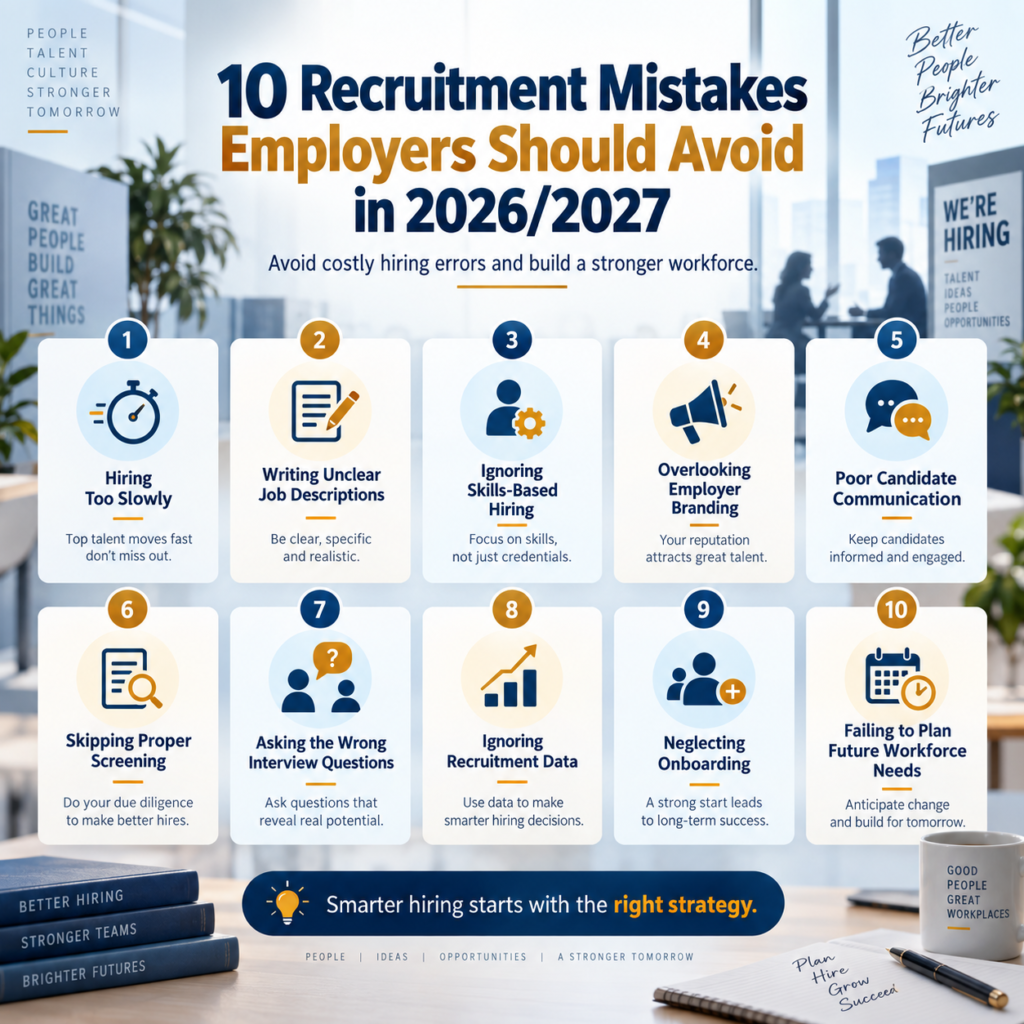
Recruitment in 2026 and 2027 is no longer simply about advertising a vacancy, collecting CVs, conducting interviews, and making an offer. Employers are recruiting in a labour market shaped by skills shortages, artificial intelligence, changing job requirements, international talent mobility, candidate expectations, and increasing pressure to improve quality of hire.
The World Economic Forum reports that nearly 40% of skills required for jobs are expected to change by 2030, while 63% of employers identify skills gaps as a major barrier to business transformation. SHRM has also reported that recruiting remains challenging for a significant share of employers.
Avoiding common recruitment mistakes can therefore help employers reduce hiring delays, improve candidate quality, control recruitment costs, strengthen retention, and build a more productive workforce.
1. Hiring Without a Clear Job Requirement
One of the biggest recruitment mistakes is beginning the hiring process without clearly defining what the organization actually needs.
A vague job description can attract hundreds of applications while producing very few suitable candidates.
Before recruitment begins, employers should clearly establish the role’s responsibilities, required technical skills, experience level, qualifications, working conditions, reporting structure, salary range, location, and expected performance outcomes.
For technical and skilled occupations, employers should also distinguish between essential competencies and preferred qualifications.
A better recruitment process begins with:
Workforce Requirement → Role Definition → Skills Identification → Candidate Profile → Recruitment Strategy
Clear requirements improve sourcing accuracy and make screening, interviewing, and final selection more effective.
2. Focusing Too Much on Degrees and Job Titles
Requiring a particular degree or previous job title when it is not actually necessary can unnecessarily reduce the available talent pool.
Modern recruitment is increasingly moving toward skills-based hiring, where employers assess what candidates can actually do rather than relying exclusively on educational credentials or previous titles.
LinkedIn reports that 93% of talent acquisition professionals believe accurately assessing candidate skills is important for improving quality of hire, while organizations conducting more skills-based searches are associated with better hiring outcomes.
Employers should therefore evaluate candidates based on a combination of:
Skills + Experience + Practical Ability + Knowledge + Professional Behaviour + Job Suitability
This is particularly important for engineering, construction, manufacturing, IT, technical trades, logistics, and industrial recruitment.
3. Hiring Based Only on the CV
A professional CV can demonstrate experience and qualifications, but it cannot always prove that a candidate can perform the actual job.
This is especially risky when recruiting technical personnel such as electricians, welders, mechanics, machine operators, HVAC technicians, equipment operators, and other skilled workers.
Employers should use appropriate assessment methods such as structured interviews, practical demonstrations, job simulations, technical questioning, portfolio evaluation, or trade testing.
SHRM notes that organizations are increasingly looking beyond resumes toward assessments that demonstrate real-world skills, although employers should avoid creating unnecessarily burdensome assessment processes that damage candidate experience.
For skilled recruitment, a stronger model is:
CV Review → Initial Screening → Technical Assessment → Practical Test → Employer Interview → Final Selection
4. Taking Too Long to Make Hiring Decisions
An unnecessarily slow recruitment process can cause employers to lose strong candidates.
Experienced professionals and high-demand skilled workers may be interviewing with several companies simultaneously. Excessive interview rounds, delayed approvals, unclear timelines, and slow communication give competing employers an opportunity to hire them first.
Every hiring process should have clear internal responsibilities and decision deadlines.
Employers should know in advance who will shortlist candidates, who will conduct interviews, who has final approval authority, and how quickly an offer can be issued.
Faster recruitment does not mean lowering standards.
It means removing unnecessary delays while maintaining effective screening and assessment.
5. Ignoring Candidate Experience
Candidates form an opinion of an employer long before they become employees.
Poor communication, complicated applications, excessive testing, unexplained delays, repeated interview changes, and disappearing after interviews can damage the organization’s employer brand.
Research cited by SHRM has highlighted continuing candidate frustration with hiring processes and the importance of effectively implemented recruitment technology rather than technology that makes the process more difficult.
Employers should provide candidates with clear information regarding the vacancy, recruitment stages, interview schedule, expected timeline, job conditions, and final decisions.
A professional candidate experience benefits both successful and unsuccessful applicants because every candidate can influence an employer’s reputation.
6. Using AI Without Human Oversight
Artificial intelligence is becoming an important recruitment tool, but treating AI as a replacement for professional judgment is a mistake.
AI can assist with candidate sourcing, job-description development, CV analysis, communications, scheduling, skills identification, and administrative recruitment tasks.
LinkedIn reports that 37% of organizations were already actively integrating or experimenting with generative AI in recruiting, with many recruitment professionals reporting meaningful efficiency gains.
However, employers still need human oversight when evaluating professional behaviour, motivation, communication, technical competence, leadership ability, and suitability for specific working environments.
Organizations should also consider privacy, fairness, transparency, data governance, and potential bias when AI is involved in candidate evaluation.
The stronger model is:
AI-Assisted Recruitment + Human Assessment + Professional Judgment
—not fully automated hiring.
7. Prioritizing Speed Over Quality of Hire
Filling a position quickly is useful only when the person hired is suitable for the job.
A poor hire can result in lower productivity, additional training, early resignation, repeated recruitment, operational disruption, and increased workforce costs.
LinkedIn reports that 89% of talent acquisition professionals believe measuring quality of hire will become increasingly important, yet only 25% feel highly confident in their organization’s ability to measure it effectively.
Employers should therefore look beyond time-to-hire and monitor outcomes such as job performance, retention, hiring-manager satisfaction, productivity, technical competency, and successful completion of probation.
Recruitment success should not be measured simply by “vacancy filled.”
It should be measured by “right person successfully performing the job.”
8. Offering an Unrealistic Picture of the Job
Overselling a vacancy may help secure an offer acceptance, but it can create serious retention problems later.
Candidates should understand the actual salary, benefits, duties, work location, schedule, accommodation conditions where relevant, contract duration, career opportunities, reporting structure, and workplace expectations before accepting the position.
This is especially important in international and overseas recruitment, where candidates may relocate thousands of kilometres for employment.
A worker who arrives and discovers that working conditions are significantly different from what was communicated may become dissatisfied or leave early.
Transparent recruitment therefore supports both candidate trust and workforce retention.
9. Failing to Check Compliance and Candidate Credentials
Skipping verification to save time can create much larger problems later.
Depending on the occupation and country, employers may need to verify education, professional certifications, technical licences, employment history, identity documents, medical requirements, and other job-specific credentials.
International recruitment can involve additional legal, immigration, employment, documentation, and regulatory requirements.
Employers should therefore establish an appropriate verification process according to the position, jurisdiction, and applicable laws.
For overseas recruitment from Pakistan, employers should also ensure that recruitment is handled through the applicable legal overseas employment framework and, where required, a properly licensed Overseas Employment Promoter (OEP).
Compliance should be incorporated into the recruitment process from the beginning rather than treated as an administrative task after selection.
10. Trying to Manage Complex Recruitment Without the Right Infrastructure
Internal HR departments can successfully manage many recruitment requirements. However, specialist, international, urgent, and high-volume recruitment may require significantly more infrastructure.
Imagine a project requiring hundreds of engineers, supervisors, electricians, welders, technicians, equipment operators, drivers, and general workers within a defined mobilization schedule.
The employer may need to coordinate nationwide sourcing, thousands of applications, candidate screening, technical testing, interviews, documentation, regulatory procedures, and deployment simultaneously.
Attempting to manage such a requirement without adequate recruitment capacity can lead to delays and poor candidate selection.
A specialist recruitment partner can help employers scale the process through:
Workforce Planning → Nationwide Sourcing → Screening → Technical Testing → Employer Interviews → Selection → Documentation → Mobilization
How Global Al Saqib Recruitment Group Helps Employers Recruit Better
Global Al Saqib Recruitment Group supports employers seeking professional, engineering, technical, skilled, semi-skilled, and general manpower from Pakistan.
Rather than simply presenting large volumes of CVs, an effective manpower recruitment process should focus on matching candidates to the employer’s actual workforce requirements.
Recruitment support can include workforce requirement analysis, nationwide candidate sourcing, CV screening and shortlisting, technical evaluation, practical trade testing, employer interviews, bulk recruitment campaigns, documentation coordination, overseas employment processing support, and workforce mobilization.
Global Al Saqib Recruitment Group supports manpower requirements across sectors including construction, infrastructure, engineering, oil & gas, energy, MEP, manufacturing, industrial operations, facility management, logistics, transportation, hospitality, healthcare, information technology, heavy equipment, and skilled trades.
For employers managing large international projects, a structured recruitment model can reduce unnecessary hiring workload while improving access to job-relevant candidates.
Building a Better Recruitment Strategy for 2026/2027
The most effective recruitment strategies increasingly combine human recruitment expertise, AI-assisted technology, skills-based assessment, strong candidate experience, employer branding, workforce analytics, compliance, and international talent sourcing.
The World Economic Forum’s labour-market research indicates that technological change and shifting skill requirements will continue reshaping jobs through 2030.
Employers that update their recruitment practices now will be better prepared to compete for talent in 2026, 2027, and beyond.
Conclusion
The biggest recruitment mistakes are often not caused by a lack of candidates.
They result from unclear requirements, poor assessment, slow decisions, weak candidate communication, excessive reliance on credentials, irresponsible automation, inadequate verification, and recruitment processes that are not designed for the scale of the hiring requirement.
Successful employers should focus on one objective:
Hiring the right people, with the right skills, for the right roles—and building a workforce that can perform and stay.